ChatGPT for Customer Service: Optimizing Its Potential With Cognitive Tech

Imagine encountering someone who effortlessly excels in various roles—a coder, scriptwriter, music composer, tutor, and more. And recently, such a versatile entity has emerged in the realm of artificial intelligence (AI): ChatGPT.
However, the question arises—does it truly represent the ultimate customer service tool, or if there are any caveats to bear in mind? Let’s delve into the specifics to know.
ChatGPT: Breaking New Ground in Customer Service
ChatGPT is an advanced AI chatbot powered by a specialized version of the GPT language model. It excels at generating text that resembles human conversation, automating responses to common customer queries. This improves self-service experiences and allows for faster resolution of customer concerns.
Fact: 88% of customers expect companies to offer an online self-service portal.
Furthermore, ChatGPT provides numerous capabilities that lighten the load on service agents and enhance the customer experience. Let's explore some of these features: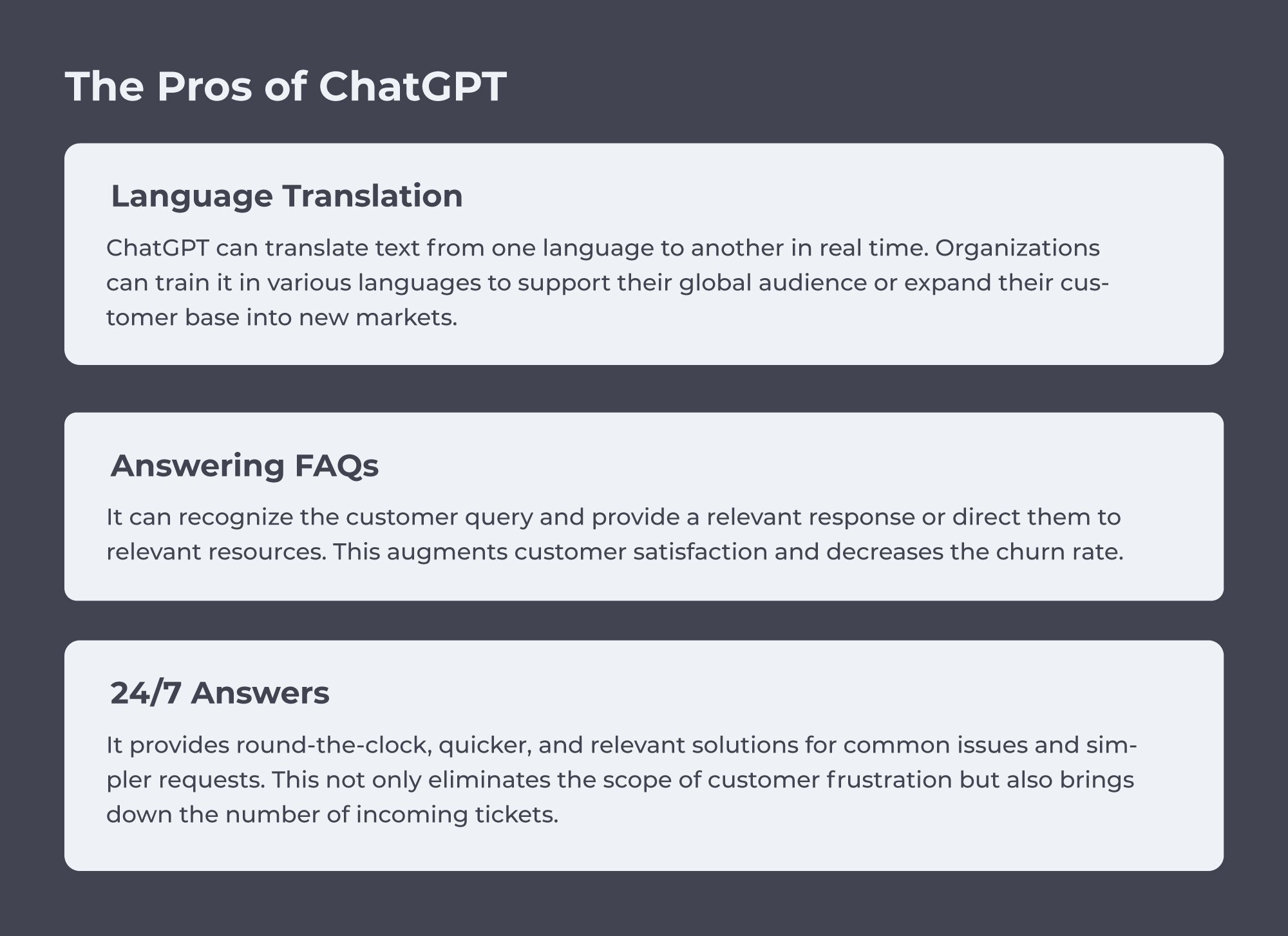
But It Isn’t All Sunshine and Rainbows
However, like any technology, ChatGPT has its limitations and challenges to consider, they are:
- Reliance on Data Availability
The effectiveness of ChatGPT hinges on the quality and diversity of the data it has been trained on. Complex customer queries may surpass its capabilities, necessitating human involvement to address certain issues effectively.
- Limited Personalization Abilities
ChatGPT is designed to generate responses but may not provide personalized interactions like a human service agent. It can give generic responses to different users, leading to potentially unsatisfactory experiences, especially when dealing with different contexts or user intents.
- Inaccurate Results:
How would you react to a person who is confidently wrong? It can be frustrating, right? Similarly, ChatGPT runs the risk of delivering inaccurate responses because it relies on patterns rather than verified facts and data.
- Privacy and Data Security Concerns:
The language model used by ChatGPT can access and potentially expose such information to all users, including those who shouldn't have access. This poses a significant risk to the security of your data.
If you're eager to delve deeper into the advantages and challenges of using ChatGPT in customer service, we invite you to watch our on-demand webinar now!
Conquer the Limitations of ChatGPT with Cognitive Technology
Let's explore the essential ways in which cognitive technology can enhance ChatGPT for your customer service function:
- Contextual and Personalized Responses:
By leveraging cognitive technology, ChatGPT can infer user intent from search queries, enabling it to deliver customized responses at scale.
- Empowering Sentiment Analysis:
Cognitive technology simplifies the accurate analysis of sentiments by going beyond a simplistic positive or negative categorization. It understands the tone of a statement, enabling ChatGPT to provide tailored responses aligned with customers' emotional states.
- Enhance Content Findability and Knowledge Creation:
New agents need time to learn about different support tickets. Without guidance, they can unintentionally cause problems. Cognitive technology and ChatGPT prevent this by providing relevant information from similar cases, eliminating the need to search for answers, and improving problem-solving efficiency.
Moreover, cognitive technology enables agents to document unknown issues as they resolve them. This creates knowledge articles on-the-fly, reducing service turnaround time.
The Verdict
While ChatGPT has its flaws and imperfections, does that mean you should retreat? Can the solutions mentioned above assist you in maximizing the benefits of ChatGPT in your service ecosystem and experiencing unmatched business success?
Let's continue the conversation in the comments section. Share your thoughts and views below!
-
@... - Would love to hear your views on this one.
0
Please sign in to leave a comment.
Comments
1 comment